Shopify vs. WooCommerce
Contents9
Related reading : Shopify vs. Wix eCommerce
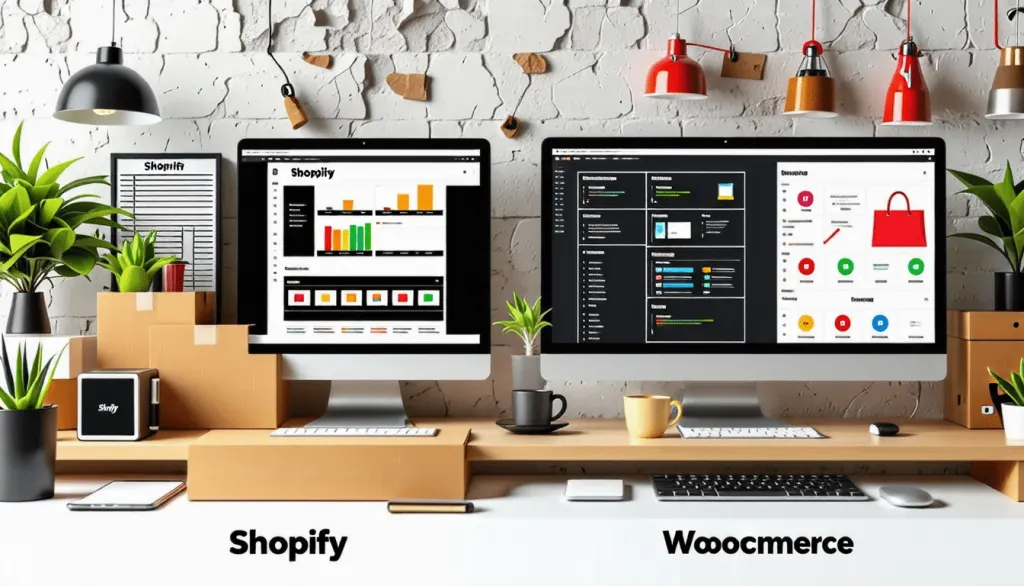
Shopify vs WooCommerce: A Duel of Giants
In the world of e-commerce, the choice between Shopify And WooCommerce is crucial for entrepreneurs. On the one hand, Shopify is distinguished by its payment system efficient and a conversion rate 17% higher on average than WooCommerce, a key indicator for maximizing sales. Additionally, Shopify offers smoother integration of multiple sales channels, allowing simplified transaction management.
Related reading : Shopify vs. BigCommerce
On the other, WooCommerce, although requiring the purchase of hosting and any themes or plugins, stands out for its impressive number of free plugins and of customizable themes. Its flexibility also allows a wide range of product variations, without strict limits, unlike Shopify.
Finally, it is essential to consider the costs of use. WooCommerce can reduce total cost of ownership, although Shopify offers unparalleled simplicity and customer support. In summary, the choice between these two platforms mainly depends on the nature of your project and your specific needs.
In the world of online commerce, choosing the right platform is essential to ensure your sales success. Two of the most popular solutions are Shopify And WooCommerce. This article compares these two options in depth, examining their features, costs, advantages and disadvantages. Shopify is often seen as a turnkey solution, while WooCommerce offers impressive flexibility thanks to its integration with WordPress. So let’s explore the notable differences between these two platforms to help you make the best choice for your online store.
Features and tools
When it comes to features, Shopify stands out with its integrated payment system, which is considered one of the best in the world. This feature simplifies the purchasing process for customers, including increasing the conversion rate, which is on average 17% higher than on WooCommerce. Additionally, Shopify offers various omnichannel sales tools, allowing users to sell on different platforms, which is not as intuitive with WooCommerce.
On the other hand, WooCommerce benefits from a wide variety of plugins and free themes, offering unlimited customization for those who want to fine-tune their store. Indeed, the platform allows you to add almost any feature imaginable, opening the door to deeper customization than Shopify, whose themes are less flexible.
Costs and Budget
From a budget point of view, the comparison between Shopify and WooCommerce is crucial. WooCommerce is a free solution, but it is essential to purchase hosting, in addition to potentially opting for themes Or paid plugins to improve the functionality of the store. This model may seem economical at first glance, but costs can quickly add up depending on needs.
Conversely, Shopify operates with a monthly subscription model, which may seem easier to manage in terms of costs, but it also incurs fixed costs each month. Shopify pricing varies depending on the plan you choose, but already includes hosting and updates, significantly reducing the risk of unexpected expenses.
Related reading : Shopify vs. Squarespace Commerce
Performance and Support
Performance-wise, it’s important to note that Shopify sites generally load faster than those built on WooCommerce. Faster loading speed is a key factor for SEO and user experience, which can play a decisive role in the conversion rate. Additionally, Shopify offers 24/7 customer support, making it easy to resolve issues quickly, while WooCommerce, as a standalone solution, relies heavily on the community for quick responses.
Scalability and Flexibility
If you are considering growing your business, scalability of the platform is an aspect that should not be overlooked. Shopify makes it possible to manage a considerable sales volume without additional technical management effort. It is particularly suitable for businesses that want to focus on sales without worrying about site maintenance.
In contrast, WooCommerce stands out for its flexibility. Although it may require more rigorous technical management, there are no rigid limits on the product variations, which can be a major asset for stores with a wide range of products to sell. This customization is crucial for businesses with specific needs.
Ultimately, the choice between Shopify and WooCommerce will largely depend on your specific needs as an entrepreneur. If you’re looking for a turnkey solution with robust customer support and good performance, Shopify could be the ideal choice. On the other hand, if you are looking for a more customizable and flexible solution, which does not hesitate to require more technical commitment, WooCommerce will undoubtedly be the best option.
- Ease of use: Shopify is known for its ease of use, while WooCommerce requires a higher learning curve.
- Payment system: Shopify offers one of the best payment systems in the world, unlike WooCommerce which requires additional configurations.
- Conversion rate: On average, Shopify has a 17% higher conversion rate than WooCommerce.
- Initial cost: WooCommerce is free but requires hosting, while Shopify offers monthly plans.
- Loading speed: Shopify sites generally load faster than WooCommerce sites.
- Customizing themes: WooCommerce offers a wider variety of free themes and plugins compared to Shopify.
- Support and assistance: Shopify offers robust customer support, while WooCommerce relies primarily on its community.
- Product variations: WooCommerce allows infinite product variations, while Shopify imposes a limit of 100 variations.
In the battle of platforms e-commerce, Shopify And WooCommerce stand out as two of the most popular choices. Each of them offers unique characteristics that can appeal to different categories of entrepreneurs. This article will highlight the pros and cons of both solutions to help you make an informed decision for your online store.
Benefits of Shopify
One of the main advantages of Shopify resides in his integrated payment system, recognized as one of the best in the world. Additionally, users can benefit from a conversion rate, on average, of 17% higher than that of WooCommerce, which means more sales for your store.
Shopify also stands out for its ease of use. The platform is very intuitive and does not require any particular technical skills, perfect for those getting started in the e-commerce. Customer support is also well-rated, offering available support for users, making it easier to resolve issues quickly.
Related reading : Shopify vs Magento
Disadvantages of Shopify
Shopify may also be its weak point. Due to its pricing structure, costs can add up quickly, although understanding these fees is simple. This is because there are fixed monthly fees and commissions on sales, which can quickly add to your budget.
Benefits of WooCommerce
For his part, WooCommerce is a WordPress plugin that offers immense flexibility thanks to its impressive number of plugins and free themes. Users have the freedom to build a site that perfectly matches their vision without having to shell out for every additional feature.
Disadvantages of WooCommerce
WooCommerce has drawbacks. The learning curve can be steeper, especially for those unfamiliar with WordPress. Additionally, WooCommerce sites tend to load slower than Shopify sites, which can impact user experience and conversions.
Read next
 Comparisons
Shopify vs. BigCommerce
Découvrez notre comparatif détaillé entre Shopify et BigCommerce. Analysez les fonctionnalités, les tarifs, et les avant
 Comparisons
Shopify vs. OpenCart
Découvrez les différences entre Shopify et OpenCart dans notre analyse approfondie. Comparez leurs fonctionnalités, flex
 Comparisons
Shopify vs Magento
Comparez Shopify et Magento pour découvrir la meilleure plateforme e-commerce pour votre entreprise. Analysez les foncti
 Comparisons
Shopify vs. PrestaShop
Découvrez les différences essentielles entre Shopify et PrestaShop pour choisir la meilleure plateforme e-commerce pour