Shopify vs Magento
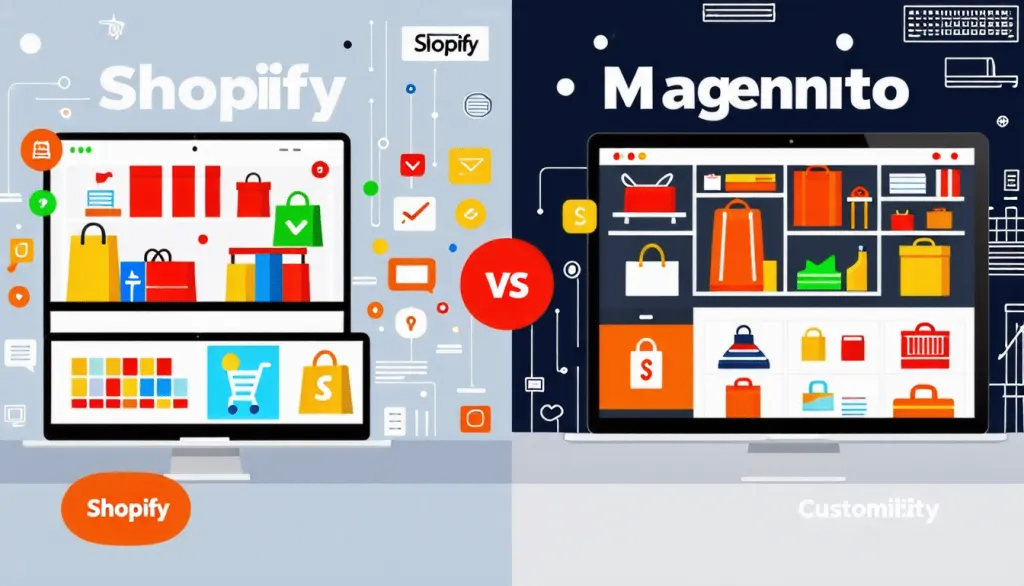
When it comes to choosing between Shopify And Magento, the decision is mainly based on the specific needs of your business. Magento, as a solution open source, is ideal for large businesses requiring extensive customization. On the other hand, Shopify is distinguished by its ease of use and its friendliness, making it a preferred choice for merchants wanting a quick and efficient setup process.
In terms of features, Magento offers greater flexibility for extending the functionality of your store, but often requires advanced technical skills. Shopify, for its part, offers many ready-to-use themes and customization tools accessible, making the creation of your site quick and easy.
Finally, if Magento may be more suitable for large companies with specific needs, Shopify is often praised for its scalability and his customer service, making it a wise choice for many startups and SMEs.
Sommaire :
Toggle
- Shopify vs Magento: A Complete Analysis
- Shopify Features
- The Advantages of Magento
- Cost Comparison
- Ease of Use and Learning
- Dropshipping and Inventory Management
- Benefits of Shopify
- Disadvantages of Shopify
- Advantages of Magento
- Disadvantages of Magento
Shopify vs Magento: A Complete Analysis
In the world of e-commerce, the choice of platform is crucial for the success of an online store. This article highlights the advantages and disadvantages of two giants of the sector: Shopify And Magento. Whether you are a first-time entrepreneur or a large company, this detailed comparison will help you determine which solution is best suited to your needs.
Shopify Features
Shopify is widely recognized for its ease of use and user-friendly interface, making it a preferred choice for those without advanced technical skills. The platform offers a wide range of ready-to-use themes and intuitive tools to personalize your store. With just a few clicks, you can launch your online store and access essential features like payment processing and order tracking.
There scalability of Shopify is also a major asset. As your business grows, the platform can easily adapt to your growing needs, and 24/7 customer service ensures continuous support. Furthermore, the wealth of third-party apps allows you to add advanced features to your store without requiring coding.
The Advantages of Magento
On the other hand, Magento, especially in its open source version, offers considerable flexibility. This platform is ideal for medium to large businesses looking to deeply personalize every aspect of their store. Thanks to an extensive catalog ofextensions, Magento allows you to add specific features and optimize store automation.
Although less intuitive than Shopify, Magento is powerful for those who want to build a highly personalized online store. It’s important to note that using this platform requires more advanced technical skills, but for businesses with an IT team, it can become a significant advantage in terms of customization.
Cost Comparison
In terms of pricing, Shopify follows a monthly subscription model with varying tiers of services, which may be easier to manage for many users. Conversely, Magento may require higher upfront costs, especially due to hosting and development services, which can be a turnoff for small businesses on a limited budget.
Ease of Use and Learning
For entrepreneurs unfamiliar with web development, Shopify is the clear winner when it comes to ease of use. The platform guides you through the setup process, while Magento requires a greater investment of time and knowledge to fully understand all of its features.
Indeed, the learning curve for Magento can be steep. However, once mastered, it allows customizations that can surpass those offered by Shopify, especially for advanced use.
Dropshipping and Inventory Management
For the dropshipping, Shopify is often preferred because of its seamless integration with several inventory management and order fulfillment applications like Oberlo and Printful. These tools allow for efficient automation, making your store management easily manageable.
Although Magento can also support dropshipping, the implementation may be less simple and require specific extensions which could incur additional costs and complex configurations.
Due to its different characteristics, both Shopify and Magento have their strengths and weaknesses. Whether you choose a simple and user-friendly solution like Shopify or a more robust and customizable platform like Magento, it is essential to carefully assess your specific needs. For a more in-depth comparison, consider checking out resources like this link.
- Flexibility: Magento offers a flexibility superior for customization and functionality expansion.
- Ease of use: Shopify stands out for its simplicity in configuration and daily use.
- Cost: Shopify has a pricing structure suitable for different budgets, while Magento may require larger investments.
- Customer Support: Shopify is recognized for its responsive customer service and accessible, unlike the complexity of Magento’s support.
- Scalability: Shopify is proven to scalability, easily adapting to business growth.
- Extensions: Magento offers a wide range ofextensions to enrich the functionality of the store.
- Business orientation: Magento is better suited to large companies with complex needs.
- Dropshipping: Shopify makes it easydropshipping integration thanks to its ease of use.
In the field of e-commerce, Shopify And Magento stand out as two of the most popular solutions for creating online stores. This article highlights the benefits And disadvantages of each of these platforms, in order to help entrepreneurs make the best possible choice for their activity.
Benefits of Shopify
Shopify is often praised for its ease of use. Whether you’re new to technology or an expert, the platform offers an intuitive interface that makes navigation easy. Customizable themes and the many tools available make it possible to create an attractive online store in record time.
Another major advantage of Shopify is its Effortless pairing with third-party apps, making features like dropshipping and advanced analytics attribution easier. Additionally, the platform offers excellent customer support, which is crucial for quickly resolving any issues that may arise.
Disadvantages of Shopify
Despite its many strengths, Shopify has some limitations. For example, although customization is possible, it is often less flexible compared to Magento. This can be a problem for businesses with very specific feature needs.
In addition, the system of Shopify pricing can become an obstacle for some companies. Transaction fees and costs associated with third-party applications can add up, potentially making the platform expensive in the long run.
Advantages of Magento
Magento, as a solution open source, offers that level of customization that many large companies are looking for. It allows a profound adaptation of the functionality and appearance of your store, meeting the unique needs of each user. Businesses can create tailored user experiences that can truly differentiate them in the market.
Additionally, Magento has a huge range ofextensions which can be integrated to improve the functionality of the store. For businesses with large sales volumes or large product catalogs, the platform is able to better manage these complexities without compromising performance.
Disadvantages of Magento
However, using Magento is not without its drawbacks. There complexity of the platform can be confusing for non-technical users. It often requires advanced development skills to take full advantage of all its features.
Furthermore, Magento can be a choice expensive for small businesses, especially when it comes to store hosting, development and maintenance. Additionally, the time required to set up a store can be long, which can frustrate some entrepreneurs looking for quick results.
Read next
 Comparisons
Shopify vs. WooCommerce
Découvrez les différences essentielles entre Shopify et WooCommerce dans notre guide complet. Comparez les fonctionnalit
 Comparisons
Shopify vs. PrestaShop
Découvrez les différences essentielles entre Shopify et PrestaShop pour choisir la meilleure plateforme e-commerce pour
 Comparisons
Shopify vs. BigCommerce
Découvrez notre comparatif détaillé entre Shopify et BigCommerce. Analysez les fonctionnalités, les tarifs, et les avant